

Plastic Optical Fiber (POF) Basics
What is Plastic Optical Fiber?
Plastic Optical Fiber, (POF), typically uses PMMA (acrylic), a general-purpose resin as the core material, and fluorinated polymers for the cladding material.
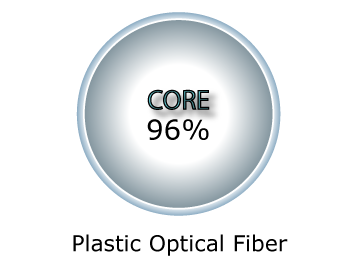
In large-diameter fibers, 96 percent of the cross-section is the core that facilitates the transmission of light.
Although quartz fiber is widely used for infrastructures, POF has been called the "consumer" optical fiber. This is due to the fact that costs of POF, associated optical links, connectors and installation costs are low. It is being focused on the following fields in particular:
- Digital home appliance interfaces
- Home networks
- Car networks
Types of Optical Fiber
The material used for POF is typically PMMA. However, there are also many other types of optical fiber. The individual characteristics of these fibers are applied to a variety of fields.
List of typical optical fibers mass-produced today:Quartz optical fiber
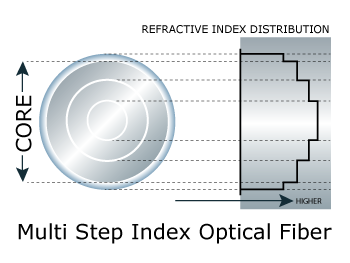
Multi-step structure fiber uses both of the principles above for transmission. As its name indicates, the structure uses multiple-step indices. Although the basic principle is the same as that of SI-POF, because the index of refraction changes in multiple steps, the focus of the light is shifted toward the center at the same time. This structure was recognized as a simple solution to increasing bandwidth.
Consumer demand for POF dictates that this fiber remain at reasonable prices. The multi-step index structure can be mass produced much easier than GI-POF. Also, since it can easily be applied to varying bandwidths by changing the number of steps, it has the added benefit of simple conversion to larger capacities in the future.
Glass optical fiber- Multi-component glass optical fiber -- Widely used along with POF for lighting
- PMMA plastic optical fiber(POF) -- Consumer short-distance fiber for electronic appliances and motor vehicles
- Polymer-clad fiber -- Fiber with a quartz core and plastic cladding
 Industrial Fiber Optics, Inc

 Mountain Standard Time